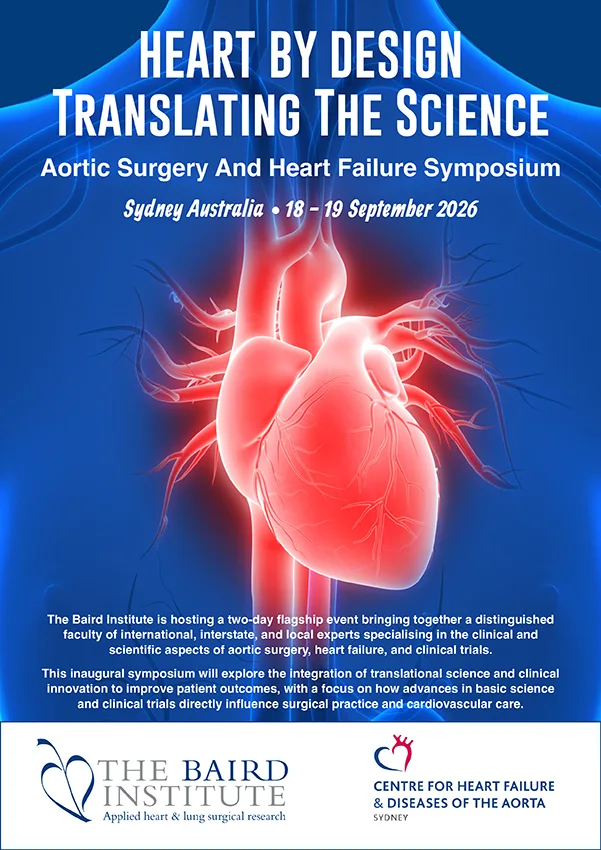
Heart by Design
Translating the Science
Aortic Surgery and Heart Failure Symposium 2026
Dates:
Friday 18th – Saturday 19th September 2026
Location:
Kerry Packer Education Centre (KPEC), Royal Prince Alfred Hospital
Charles Perkins Centre (CPC), University of Sydney
About the Symposium
The Baird Institute is hosting a two-day flagship event bringing together a distinguished faculty of international, interstate, and local experts specialising in the clinical and scientific aspects of aortic surgery, heart failure, and clinical trials.
This inaugural symposium will explore the integration of translational science and clinical innovation to improve patient outcomes, with a focus on how advances in basic science and clinical trials directly influence surgical practice and cardiovascular care.
The program has been prepared to benefit clinicians, surgeons, researchers, scientists, nurses, allied health and industry professionals with an interest in aortic disease, heart failure, clinical trials and translational cardiovascular research.
Event Highlights
Clinical Trial Workshops
Time: Friday 18th September – 12pm to 4.30pm
Venue: Institute of Academic Surgery Royal Prince Alfred Hospital
Details:
Practical, interactive sessions designed to educate health professionals on establishing and conducting clinical research.
Cocktail Event
Time: Friday 18th September – 5pm to 7pm
Venue: Charles Perkins Centre The University of Sydney
Details:
Includes a guided tour of the Translational Research Facility and Hybrid Theatre at the Charles Perkins Centre, the University of Sydney.
Main Symposium
Time: Saturday 19th September – 8.30am to 4.30pm
Venue: Charles Perkins Auditorium – The University of Sydney
Details:
Featuring cutting-edge developments in:
- Aneurysm formation and early detection
- Precision care in aortic disease
- Cardiometabolic and pathogenetic mechanisms of heart failure and cardiomyopathy
- Mechanical support for cardiogenic shock
- Cardiac regeneration and future therapies
Keynote Speakers
Professor William Pu
Professor William Pu is the director of Basic and Translational Cardiovascular Research in the Department of Cardiology at Boston Children’s Hospital, and the Aldo R. Professor of Paediatrics at Harvard Medical School. Professor Pu has broad expertise in cardiac biology that includes cardiac development, heart failure, cardiac regeneration, and in vitro cardiac disease modelling. His lab has made fundamental discoveries in gene regulation in developing and diseased hearts, particularly in the area of transcriptional regulation. Many of these discoveries are the result of innovative approaches to studying heart development and disease, often involving multidisciplinary collaborations that draw on advances in other fields. His lab is currently engaged in research projects on the genetic causes of inherited heart diseases, and gene therapy for Barth Syndrome and CPVT.
Professor Pu completed his combined BS-MS degree at Yale University and obtained his MD degree from the Harvard Medical School/MIT Science and Technology Program in 1993. He trained in paediatrics and paediatric cardiology at Boston Children’s Hospital. He received his training in basic research in the laboratories of Kevin Struhl, David Clapham, and Seigo Izumo. He established an independent research lab at Boston Children’s in 2004.
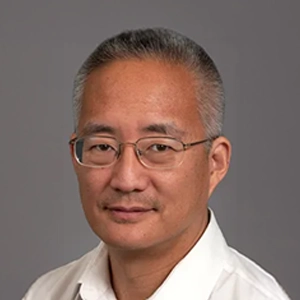
Professor Michael Fischbein
Michael P. Fischbein, MD, PhD, is the Thelma and Henry Doelger Professor of Cardiovascular Surgery at Stanford University School of Medicine. He serves as Director of Aortic Surgery and Residency Program Director for the Department of Cardiothoracic Surgery. Dr. Fischbein specializes in valvular heart disease and thoracic aortic surgery. He is the Chair of the AATS Cardiac Education Committee, Adult Cardiac Subgroup Lead on the AATS Membership Committee, and Program Director of the AATS Cardiac Surgery Biology Club. He is a past President of the Western Thoracic Surgical Society and past Chair of the AHA CVSA Council. Dr. Fischbein is an Associate Editor for JTCVS Adult Cardiac Surgery.
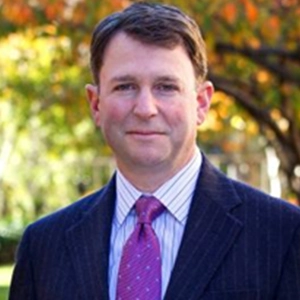
Professor David Kaye
Professor David Kaye is an internationally recognised cardiologist and translational scientist specialising in heart failure and cardiac transplantation. He is Director of Cardiology at The Alfred Hospital and leads the Heart Failure Research Program at the Baker Heart and Diabetes Institute. He is an NHMRC Senior Principal Research Fellow and Adjunct Professor at Monash University.
Professor Kaye’s work spans mechanistic discovery through to first-in-human studies and commercial translation, with a focus on identifying novel therapeutic targets in heart failure. He has made major contributions to understanding the pathophysiology of heart failure, including autonomic dysfunction, myocardial energetics, and more recently HFpEF, where his group has defined key roles for ageing, hypertension, and the gut–cardiac axis.
A hallmark of his career is the translation of biological insights into therapeutic platforms, including development and clinical evaluation of novel pharmacological and device-based strategies for advanced heart failure. This includes leadership of early-phase clinical trials and participation in international multi centre studies, as well as contributions to the development of first-in-class therapies progressing toward commercialisation.
Professor Kaye has authored over 420 peer-reviewed publications in leading journals and has established one of the premier translational heart failure programs in the Asia–Pacific region, integrating human physiology, experimental models, and clinical trials to accelerate therapeutic innovation.
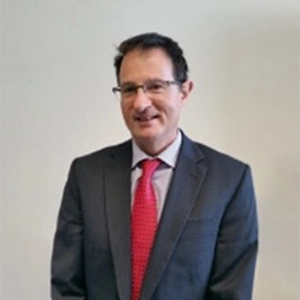
Professor Alistair Royse
Professor Alistair Royse – An accomplished cardiothoracic surgeon, educator and researcher. based at The Royal Melbourne Hospital and The University of Melbourne.
He has had a long-standing career in cardiothoracic surgery since the mid-1990s, with particular expertise in coronary artery bypass surgery and total arterial revascularisation. Professor Royse is widely recognised for pioneering the use of the radial artery as a conduit in coronary bypass surgery, helping to significantly change surgical practice in Australia and internationally.
In addition to his clinical work, he is a leading figure in cardiovascular research and surgical innovation, with interests spanning minimally invasive techniques, sutureless valve technologies, and advanced grafting strategies.
Professor Royse also has a strong focus on education and training, serving as Director of eLearning Technologies at the University of Melbourne and co-leading ultrasound education initiatives that have advanced perioperative imaging and clinician training.
Event Registration
Questions & Enquiries
If you any questions or general enquiries regarding this event, please email us below:

Sponsorship Opportunities
Would your organisation like to support this flagship event through corporate sponsorship?
We are proud to be partnering with the following organisations:
Event Sponsors
We sincerely thank the organisations whose generous support has helped make The Baird Institute Symposium possible. Their commitment enables us to bring together leading clinicians, researchers and health professionals to share knowledge, explore advances in cardiothoracic care and research, and foster collaboration.
Gold Sponsor

Silver Sponsors